Building Virtual Spaces, Not Apps
VR adoption stalls on content, not hardware. Metasteps lets museums and educators build immersive spaces without a studio or build pipeline.
Walk into any modern conversation about virtual reality, and you will hear about hardware. Headsets are lighter, displays are sharper, and prices keep coming down. Yet adoption still stalls, not because the devices fall short, but because there is too little reason to put them on. The missing ingredient is not pixels. It is content. For museums, universities, and other organizations sitting on rich material, the gap between “we have something worth experiencing” and “people can experience it in VR” remains too wide. An immersive content platform like Metasteps is designed to close that gap by turning spatial creation into a web workflow and treating each experience as a space, not a software product.
The VR content gap nobody talks about
VR adoption is often framed as a hardware problem: headset cost, comfort, battery, resolution. Those matter, but the deeper bottleneck is supply. Most VR experiences still live behind specialist XR teams, game-engine pipelines, platform-specific builds, and app store deployments. Every update requires another technical pass. That is workable for a flagship title from a studio, but it is the wrong shape entirely for a regional museum that wants to publish a new exhibition each season, or a faculty member who wants students to walk through a reconstructed site for a single semester.
The result is a thin, sluggish content layer. Headsets keep improving. The reasons to keep them in regular use do not. To make VR genuinely useful, the people closest to the material (curators, educators, researchers, designers) need to be able to build for it themselves, without becoming software engineers.
What VR actually adds beyond the screen
Before solving the production problem, it helps to be clear about why VR is worth the effort in the first place. The shift is not visual fidelity. It is the relationship between the viewer and the content.
In 2D, users look at information through pages, slides, catalogues, and videos. In screen-based 3D, they can navigate a model, but they still observe it from outside the frame. In VR, users feel placed inside the space. That presence brings scale, atmosphere, focus, spatial memory, embodied exploration, and a different quality of emotional engagement.
For a museum, this changes what a virtual visit can be. A high-resolution photograph of a gallery preserves the artifacts. A walkable VR space preserves the experience of being among them, the sense of distance between objects, the height of a sculpture, the rhythm of moving through a room. For an educator, that same property lets a learner connect ideas to places, not just to slides. The simple way to say it: 2D shows content, 3D lets users explore it, VR lets them feel present inside it.
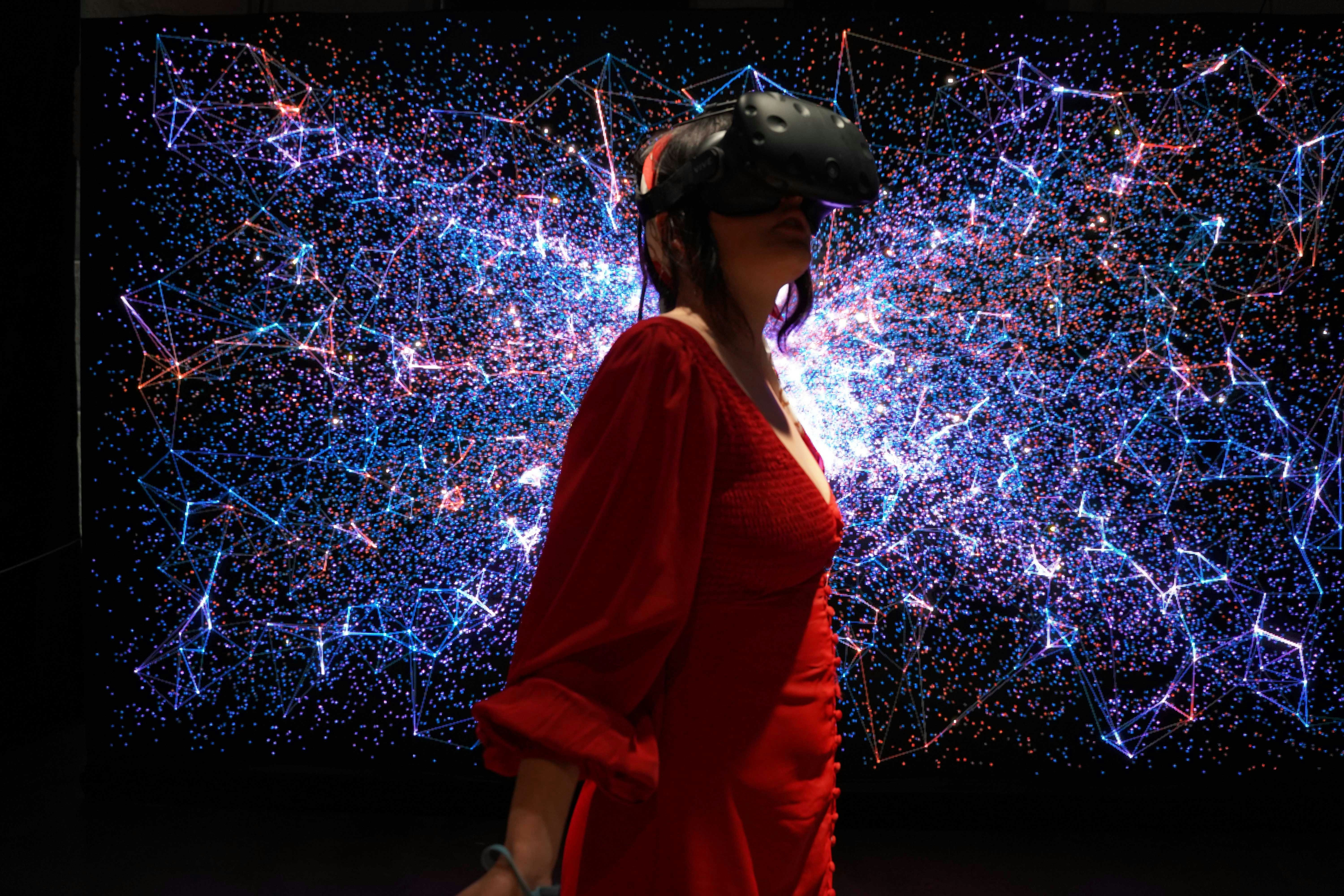
Photo by Sara Kurig on Unsplash
Where immersion actually pays off
Not every piece of content needs VR. The honest question is when the spatial dimension changes the outcome. A few cases where it tends to:
- Virtual exhibitions. Curators can recreate or reimagine a show, extend its lifespan beyond its physical run, and reach visitors who could never travel to see it in person.
- Classrooms and student work. Learners move through environments tied to a curriculum, and student cohorts can publish their own exhibitions as part of coursework.
- Training and onboarding. Even when an environment is not a full simulation, walking through layout, sequence, and decision points beats reading a manual.
- Guided learning paths. Audio, signage, and ordered routes can shape attention in ways a slide deck cannot.
- Collaborative reviews. Teams and faculty can meet inside a space, point at things, and discuss what is actually there.
The pattern across these is consistent: VR earns its place when learning, communication, or appreciation depend on context, space, and shared attention.
Spaces, not apps
The reason this content layer has stayed thin is structural. Most VR production still looks like shipping software. You design an application, build scenes in a game engine, package assets, prepare platform-specific builds, deploy through stores or enterprise channels, and repeat the cycle for every meaningful update. That is heavy lifting for any institution, and it is the wrong cost model for content that should refresh as often as a website does.
Metasteps starts from a different assumption. The unit of work is a space, not an application. Creators assemble immersive environments through the web using familiar content types: images, videos, 3D objects, text, PDFs, audio, guided paths, and interactive elements. The space becomes the deliverable. There is no build pipeline to manage, no release cycle to coordinate, no separate version for each platform.
That changes who can produce VR content and how often. A curator can update a gallery between exhibitions. A teacher can prepare a new room for a unit. A studio can publish a showroom and revise it without recutting a build. After creating or updating a space, users can step into it in VR to check what only an inside view will reveal: object scale, readability, room layout, visitor flow, comfort, atmosphere, navigation. The loop between creation, publishing, review, and refinement gets short enough to be practical.
A different workflow, in practice
For museums and cultural organizations, this looks like building a virtual wing the same way you would build a microsite, except the result can also be experienced in VR when presence matters. For higher education, it looks like producing a virtual classroom or fieldwork space inside an academic calendar rather than a software release schedule. In both cases, the team closest to the content is the team that builds it.

Photo by James Yarema on Unsplash
Why this matters for VR as a whole
Better headsets will keep arriving. Better content is what gives people a reason to use them. By treating immersive experiences as spaces rather than applications, an immersive content platform makes it realistic for museums, universities, and creators to publish often, iterate quickly, and reach audiences who can engage on flat screens and step inside when the experience calls for it.
The takeaway for cultural and educational organizations is direct: you do not need a studio to enter VR. You need a workflow that fits how you already produce content and a way to let presence, scale, and spatial memory do the work flat media cannot.
If your team has material that would benefit from being walked through rather than scrolled past, explore Metasteps or get in touch to see how a web-first approach to immersive space creation could fit your next exhibition, course, or program.