I had previously tried Spatial.io, but the results weren't visually pleasing. Objects became elongated when moving through the space, and the options for customising the environment were very limited.
"Metasteps gives so much more creative freedom."
How a one-person virtual museum in Stockholm is running multiple curated art and history exhibitions.
THE CHALLENGE
A museum where the presentation is the product
The Vimu is a virtual museum based in Stockholm, run by one person. It builds curated exhibitions on art and history for an audience of people interested in both. Its published collection spans antiquities from Africa, Asia, Europe, Mesoamerica and the Middle East alongside painting, print, sculpture, maps and photography, and its stated mission is to break down the geographical, financial and physical barriers to cultural heritage.
For a museum that exists only online, presentation is the entire visitor experience. Artworks had to hang in different frames. Environments had to look considered rather than generic. 3D models had to upload at a size worth looking at. The platform in use at the time could not deliver any of it well.
That platform was Spatial.io. Objects distorted as visitors moved through the space, stretching out of shape. Customisation of the environment was narrow, and the framing options were limited enough to undercut the point of a virtual museum. Time and budget were both constrained, though manageable; the one thing that could not be compromised was the quality of the 3D worlds.
THE SOLUTION
Better rooms and frames to hang the work in
The search started with market research on Google for 3D spaces, where Metasteps came up. Three alternative options were on the table: staying on Spatial.io, moving to Kunstmatrix, or building the spaces from scratch in Unity. The criteria were specific: high-quality graphics and the ability to upload images and 3D models at a decent size.
What decided it was the combination: better graphics, the frames, a platform clearly built for exhibitions rather than adapted to them, and the option to build guided tours inside an exhibition. The 3D environments and the loading times both stood out on first glance.
The expectation was better-looking rooms but what landed harder was the range: the variety of materials, and how quickly an environment or its ambient sound could be swapped for something else. For a curator working alone, being able to restyle a room without asking anyone is the difference between one exhibition a year and a programme.
The deciding factors were the nicer graphics, the frames, the clear focus on exhibitions, and the possibility to create guided tours within the exhibitions.
THE RESULT
One person, running multiple museums
The Vimu now builds virtual exhibitions on art and history with interactive tours inside them. 3D objects and artworks go in alongside a full set of choices over environment, sound, space, interiors, colour and framing, all of it reachable without help.
The usability cuts both ways, which for a museum of one matters more than it would for a team. Anyone with basic computer skills can work the platform as a creator; anyone with basic computer skills can also arrive as a visitor and find their way around.
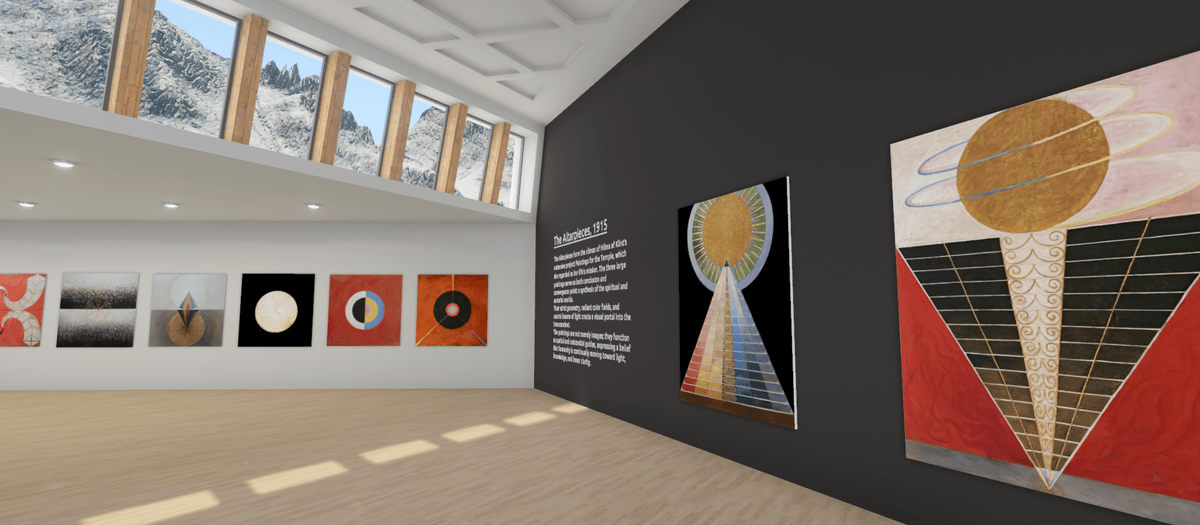
Two exhibitions are live at the time of writing: Sacred Femininity in Ancient Greece, and Geometry of the Spirit, on Hilma af Klint. The audience is international: visitor testimonials come from Austria, the United Kingdom, Canada and Australia, and include a history teacher using the exhibitions in class.
The exhibitions reach a paying audience, which for a one-person cultural organisation is the difference between a project and a business.
Fredrik is planning to grow the ViMu with exhibitions on Van Gogh, the Maya, Agnes Pelton and John Bauer planned.
The advice that comes with that is practical, and worth repeating for anyone starting: decide how the space should look before opening the editor. The number of choices is itself a hazard: it is easy to spend your time styling interiors instead of building the exhibition you sat down to build.
Hilma af Klint: Geometry of the Spirit
Visit the space for yourself and see what Metasteps' platform is capable of.
Visit the spaceBuild the museum you can't afford to build.
Upload the work, choose the room, and open a curated exhibition people can walk through.