There was no easy way to provide an entire classroom with a friendly platform to intuitively design a virtual exhibition.
"Metasteps is my students' playground."
How Leiden University's Faculty of Archaeology turned seminar assignments into 3D exhibitions that their students build themselves.
THE CHALLENGE
Trapped in the wrong software
The Faculty of Archaeology at Leiden University is home to around 800 people, 100 staff and 700 students and ranked 4th in the QS World University Rankings by subject. In the Department of Archaeological Sciences, Dr. Martina Revello Lami teaches BA and MA students how objects carry meaning. Her own specialism is pre-Roman Italy and ceramic studies, and her research has increasingly turned to how antiquity is understood by people today, close to the problem she set out to solve in her teaching.
The idea was already in place: have students design exhibitions, so they handle meaning rather than read about it. The tools were the problem: architecture software turned exhibition design into a technical course in its own right as their learning curve was a steep climb for students who are not architects. The tools were also so heavy that not every available laptop could run them.
Although engagement was the entire point of the assignment, the software enabling it had become the thing standing between the students and their goal.
THE SOLUTION
Enter Metasteps
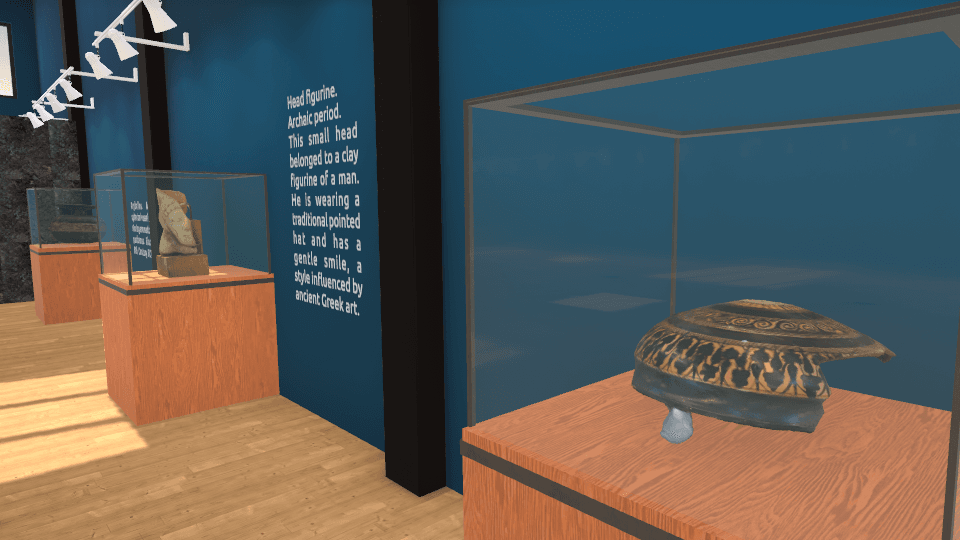
The faculty trialled Metasteps for a year before subscribing. The working model is straightforward. The professor sets up the spaces and the Districts while the students do the building. Non-public Districts let them work with unpublished research data without copyright exposure, and larger file allowances mean 3D replicas of real artefacts go into the exhibitions instead of photographs.
Metasteps won on the things that decide whether a classroom tool survives contact with a classroom: an interface students learn without a manual, flexibility in the file formats they could bring, a subscription that flexed with the course, and support that answered quickly.
Metasteps changed what the exhibitions could look like: considerably more freedom to shape an environment around the narrative of each exhibition.
THE RESULT
Work the students are proud to sign their own names to
Students build and publish their own 3D exhibitions as coursework while the professor curates the framework; this is the shift that made the assignment work. The people doing the learning are the people deciding what goes where, and why.
In June 2026 Leiden published a story about Galleria at the National Museum of Antiquities in Leiden, where Revello Lami acted as guest curator for a section called "Learning from the Past" built around the Faculty's former teaching collection of Mediterranean ceramics, transferred to the museum in 2023. One of the exhibition's digital components is a virtual gallery developed by MA student Dimitris Pavlou within his thesis project, offering alternative ways of telling the stories behind museum objects.
Unpublished research data stays protected inside non-public Districts, so students can work with material that has not been released. 3D replicas of real artefacts bring material culture into the exhibitions at full fidelity, essential for a course about how objects carry meaning.
The direction of travel in the Faculty's own teaching points the same way: students are now taught to create digital records using 3D scanning, working with advanced equipment through a collaboration with the Leiden Learning and Innovation Centre. Building the exhibition and digitising the object have become parts of the same skill set.
Give your students a playground of their own
Book a demo and see a class built on your syllabus, or start a trial and set up the first space.